
What Happens When You Send BNB
Last updated: June 2, 2026
When you send BNB to a casino, the transaction is confirmed on-chain in about 3 seconds and costs a few cents in gas. But between hitting “send” in your wallet and seeing the balance appear in your casino account, several things happen that most players never see — and understanding them is the difference between knowing your deposit is fine and panicking when it takes two minutes instead of one. If you’re depositing at crypto casinos that accept BNB, this is the plumbing worth understanding.
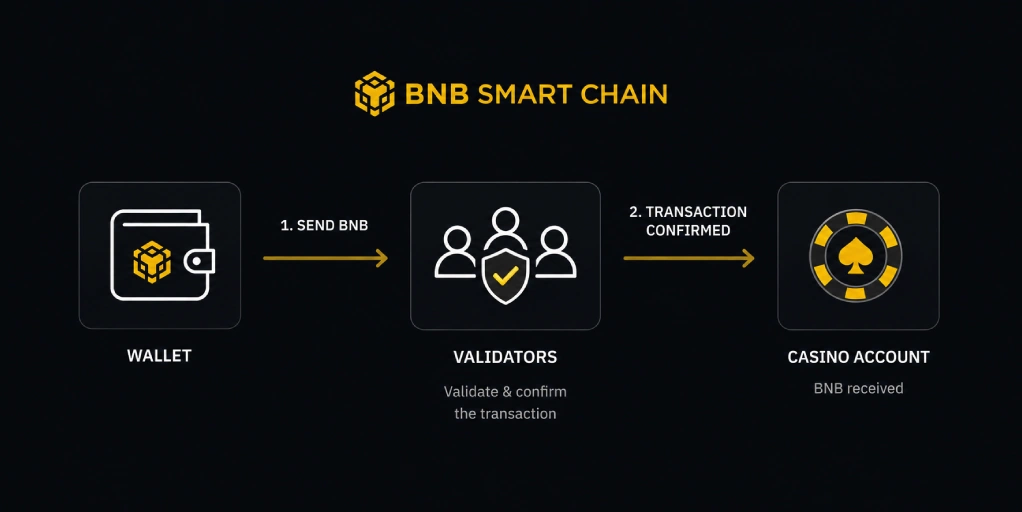
Table of contents
The Anatomy of a BNB Transaction
Every BNB transaction is a small package of data broadcast to the BNB Smart Chain network. It contains a few key pieces: the sender’s address, the recipient’s address, the amount of BNB being moved, a gas fee to pay for processing, and a digital signature proving the sender authorised it. That signature is created by your wallet using your private key — which is why nobody can move your funds without access to that key.
Once signed, the transaction gets a unique identifier called a transaction hash — a long string starting with 0x that acts as its permanent receipt. You can paste that hash into a block explorer and see the transaction’s status at any time. When a casino’s support team asks you to “send the TX hash” for a missing deposit, this is what they mean. It’s the single most useful piece of information you have when something needs tracing.
What Happens After You Hit Send
The moment you confirm a send in MetaMask or Trust Wallet, your transaction enters the mempool — a waiting area where pending transactions sit before being added to the chain. On a congested network like Ethereum, transactions can linger here for minutes during busy periods. On BNB Smart Chain, the wait is usually negligible because blocks are produced every 3 seconds and capacity is high.
BNB Smart Chain uses 21 active validators that take turns producing blocks. When it’s a validator’s turn, it bundles pending transactions — including yours — into a new block and adds it to the chain. Your transaction is now “confirmed” once, meaning it’s recorded. Each subsequent block built on top of it adds another confirmation, making it progressively harder to reverse. For the deeper technical background on this validator system, our guide to what BNB Smart Chain is covers how PoSA consensus works.
The whole process from broadcast to first confirmation typically takes under 5 seconds. That speed is exactly why so much BNB gambling happens on BSC rather than Ethereum — the deposit experience feels closer to a card payment than a traditional crypto transfer.
Gas Fees, Explained
Gas is the fee you pay validators to process your transaction. On BNB Smart Chain it’s paid in BNB — always, regardless of which token you’re sending. A standard BNB transfer costs roughly 0.000105 BNB in gas, which at typical prices works out to under $0.10. Sending a BEP-20 token like USDT costs slightly more because it involves a smart contract call, but it’s still usually under $0.30.
The fee is the same whether you send 0.01 BNB or 10 BNB — gas is priced by computational complexity, not transaction value. This flat structure is what makes small deposits and frequent withdrawals practical on BSC in a way they never were on Ethereum at peak fees. One thing that trips people up: you must always keep a little BNB in your wallet for gas, even if you only hold other tokens. An empty BNB balance means you can’t send anything. Our breakdown of BNB transaction speed and fees at casinos goes into the numbers in more detail.
Confirmations and Why Casinos Wait for Them
A single confirmation records your transaction, but most casinos wait for several before crediting your deposit. The reason is a safety margin against chain reorganisations — rare events where the most recent blocks get reshuffled. Waiting for 15 to 20 confirmations makes the deposit effectively irreversible, which protects the casino from crediting funds that later vanish.
At 3 seconds per block, 15 confirmations take roughly 45 seconds to a minute. That’s the on-chain portion of your wait. If a deposit is taking noticeably longer than that, the delay is almost always on the casino’s processing side rather than the network. Understanding this distinction saves a lot of unnecessary worry — and tells you whether to wait or to contact support. Our guide on why BNB withdrawals get delayed covers the casino-side causes in depth.
The Casino Side of the Transaction
The blockchain’s job ends when your transaction is confirmed. Everything after that is the casino’s software. The platform runs a system that watches its deposit addresses for incoming transactions, counts confirmations, and credits your account once the threshold is met. A well-built casino does this automatically within seconds of the final confirmation. A poorly built one might batch deposits, process them manually, or simply have a slow detection system.
This is why the same BNB transaction can credit instantly at one casino and take ten minutes at another, despite identical on-chain confirmation times. The network behaves the same everywhere; the platform doesn’t. It’s one of the things we test directly in our casino reviews — actual deposit and credit times on live BNB transactions, not the marketing claims. Platforms like Winz and Bets.io have handled this consistently well in our testing.
Reading a Transaction on BscScan
BscScan is the block explorer for BNB Smart Chain — a public website where every transaction on the network is visible. Paste your transaction hash into the search bar and you’ll see its full status: whether it succeeded, how many confirmations it has, the gas paid, the sender and recipient addresses, and the exact timestamp. For any deposit question, this is your source of truth.
The status field is the first thing to check. “Success” means the transaction went through and the network did its part — if your casino balance hasn’t updated, the issue is on their end. “Pending” means it’s still being processed. “Failed” means something went wrong, usually insufficient gas, and the funds never left your wallet. Knowing how to read this turns a stressful “where’s my money” moment into a 30-second check. Our step-by-step guide on how to check BNB transactions walks through it with screenshots, and if a transfer is stuck, the stuck transaction guide covers what to do next.
Once you understand how transactions move, the rest of BNB gambling gets a lot less intimidating. To put it into practice, see our guide on BNB casino deposits, and when you’re ready to choose where to play, browse our current list of casinos accepting BNB.
Always gamble responsibly. Read our responsible gambling page for practical guidance, and see our advertiser disclosure for affiliate information.
FAQ
- How long does a BNB transaction take?
The on-chain part is fast — under 5 seconds to the first confirmation, and roughly 45 to 60 seconds for the 15 to 20 confirmations most casinos require. Total deposit time depends on the casino’s processing speed after that. - What is a transaction hash?
A transaction hash (or TX hash) is a unique 0x-prefixed code that identifies your transaction on the blockchain. It’s your permanent receipt. Paste it into BscScan to check status, and send it to casino support if a deposit is missing. - Why do I need BNB for gas if I’m sending USDT?
Gas on BNB Smart Chain is always paid in BNB, no matter which token you move. Sending BEP-20 USDT still requires a small BNB balance for the fee. If your BNB is at zero, the transaction can’t be processed. - What does “confirmation” mean for a BNB deposit?
A confirmation is each new block added on top of the one containing your transaction. More confirmations make it irreversible. Casinos typically wait for 15 to 20 before crediting, which takes about a minute on BSC. - My BscScan shows “Success” but the casino hasn’t credited me. Why?
The network did its job — the delay is the casino’s processing system. Wait a few minutes, then contact support with your transaction hash. A “Success” status confirms the funds reached the deposit address. - Can a BNB transaction fail?
Yes, usually from insufficient gas. When a transaction fails, the BNB you were sending stays in your wallet, but the small gas fee for the attempt is still consumed. Make sure you have enough BNB to cover both the amount and the gas. - Are BNB transactions reversible?
No. Once confirmed on the blockchain, a transaction cannot be reversed or cancelled. This is why confirming the recipient address and network before sending matters so much — and why sending a small test amount first is a smart habit. - Is my BNB transaction private?
The blockchain is public — anyone can see the addresses, amount, and timestamp on BscScan. But addresses aren’t automatically linked to your identity. The transaction shows wallet addresses, not names, unless that link is established elsewhere.

BNB Casino is an independent website reviewing crypto casinos that accept BNB. We are not a gambling operator and do not accept bets or process payments. Some links are affiliate links, meaning we may earn a commission at no extra cost to you. 18+ only. Please gamble responsibly.