
Is BNB Gambling Legal? What the Law Says
Last updated: June 13, 2026
Whether BNB gambling is legal depends entirely on where you live. There’s no single global answer — gambling law is set by individual countries and sometimes by regions within them, and the rules range from fully regulated and permitted, to unregulated grey areas, to outright prohibition. The cryptocurrency itself is legal to own in most of the world, but using it to gamble is governed by your local gambling laws, not by crypto rules. This guide explains how to think about the legality of BNB gambling, the different categories of jurisdiction, and why the responsibility to check your own local law always rests with you.
Important: This article is general information, not legal advice. Gambling and cryptocurrency laws vary by country and change over time. Before gambling with BNB, check the current laws in your own jurisdiction, and consult a qualified legal professional if you are unsure.
Table of contents
The Short Answer: It Depends on Where You Live
Gambling is one of the most jurisdiction-specific areas of law. What’s perfectly legal in one country can be a criminal offence in another, and the rules can differ even between states or provinces within a single country. There is no international standard, and no blanket answer that applies everywhere.
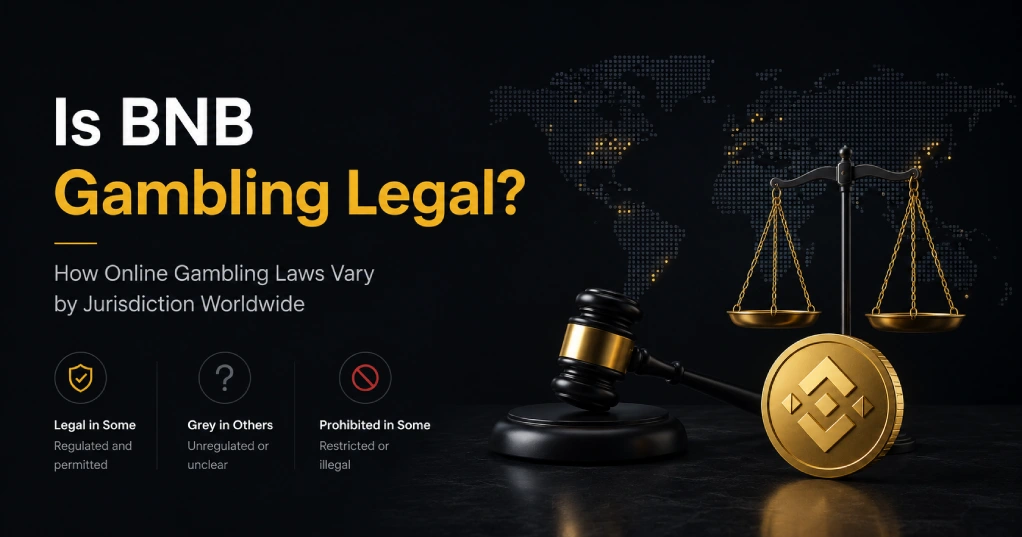
This means the legality of BNB gambling for you specifically comes down to your local laws. Some jurisdictions licence and regulate online gambling, including crypto gambling. Others have no specific framework, leaving it in an unregulated grey area. Others prohibit online gambling entirely, and a few restrict cryptocurrency use on top of that.
Because the situation is so varied and changes regularly as governments update their laws, the only reliable approach is to research the current rules where you live before you gamble. This guide gives you the framework to understand what you’re looking for, but it cannot tell you the law in your specific location.
Two Separate Questions
It helps to separate two distinct legal questions that often get tangled together.
Is owning and using BNB legal? In most countries, owning cryptocurrency like BNB is legal. You can buy, hold, and transfer it freely. A minority of countries restrict or ban cryptocurrency, and a few have specific rules about how it can be used. For the vast majority of players, the cryptocurrency itself is not the legal issue. If you’re new to BNB as an asset, our guide on what BNB is explains the basics, and how to buy BNB covers acquiring it legally through regulated exchanges.
Is online gambling legal? This is the question that actually determines whether BNB gambling is legal for you. The law treats the act of gambling according to your gambling regulations, regardless of the payment method. If online gambling is legal and regulated where you live, doing it with BNB is generally subject to the same rules as doing it with any other currency. If online gambling is prohibited where you live, using BNB doesn’t change that.
In other words, BNB is usually not the deciding factor — your local gambling law is. The payment method rarely creates or removes legality on its own. The mistake some players make is assuming that because crypto is decentralised, it sits outside gambling law. It does not; the gambling activity is still governed by the rules where the player is located.
The Three Categories of Jurisdiction
While the specifics vary enormously, most jurisdictions fall into one of three broad categories when it comes to online and crypto gambling. Understanding which type yours is in is the starting point for your own research.
| Category | What It Means |
|---|---|
| Regulated and permitted | The jurisdiction licenses online gambling operators and allows residents to play at licensed sites. Crypto may or may not be specifically addressed, but gambling itself is legal and overseen. |
| Unregulated grey area | No specific law permits or prohibits online or crypto gambling. Many players access offshore-licensed sites, but there is little or no local legal framework or protection. |
| Prohibited | Online gambling, or gambling generally, is illegal. Using crypto does not make it legal, and players may be breaking the law by participating. |
These categories are a simplification. Real legal situations are often more nuanced — a jurisdiction might permit some forms of gambling and prohibit others, regulate operators but not address crypto, or have laws that exist on paper but aren’t enforced. Some places regulate at a national level, others delegate to states or provinces with conflicting rules.
The practical point is to identify which category broadly applies to you, then research the specifics. A regulated jurisdiction will usually have a gambling authority whose website lists licensed operators and explains the rules for residents. That’s the authoritative source for your situation — far more reliable than any general guide.
How Offshore Licensing Fits In
Most BNB casinos hold offshore licenses — commonly from Curaçao, and sometimes Malta or other jurisdictions. It’s worth understanding what these licenses do and don’t mean for you as a player.
An offshore license means the operator is regulated in the jurisdiction that issued it. The casino is legally established and overseen somewhere — it’s not operating with no accountability at all. This is meaningful for the operator’s legitimacy and gives players a route to complain to the licensing authority if something goes wrong. Our guide on whether BNB casinos are safe covers why verifying a license matters for platform trust.
However, an offshore license does not override your local law. A casino being legally licensed in Curaçao doesn’t make it legal for you to play there if online gambling is prohibited where you live. The license governs the operator’s standing in its own jurisdiction; it says nothing about your legal position as a player elsewhere. This is a crucial distinction that’s often misunderstood — the casino’s legality and your legality are two separate things.
Many offshore-licensed casinos also restrict players from certain countries in their terms and conditions, precisely because of these jurisdictional issues. If a casino’s terms exclude your country, registering anyway typically violates those terms and can lead to a refused payout, regardless of the license.
The Player’s Responsibility
The consistent theme across all of this is that the responsibility to gamble legally rests with the individual player. No casino, guide, or third party can determine your legal position for you, and “I didn’t know” is rarely a defence if local law is broken.
Before gambling with BNB, the responsible steps are to confirm whether online gambling is legal where you live, check whether any cryptocurrency restrictions apply, read the casino’s terms to confirm your country isn’t excluded, and understand your tax obligations on any funds you receive. If any of this is unclear, a qualified local legal professional is the right source — not a gambling site.
This site provides information to help players understand BNB gambling, but it cannot and does not advise on the legality of gambling in any specific location. Where online gambling is legal for you, our how to choose a BNB casino guide helps you select a reputable, licensed platform. Where it isn’t legal, the responsible choice is not to participate.
Tax Considerations
Even where gambling is legal, there can be tax implications, and these are also entirely jurisdiction-specific. Some countries tax gambling proceeds; others don’t. Some treat cryptocurrency disposals as taxable events separately from gambling, which adds another layer when BNB is involved.
Because BNB’s value changes over time, there can be a difference between the value of BNB when you received it and when you converted or spent it — and in some jurisdictions that difference is itself relevant for tax. This is genuinely complex, varies widely, and is exactly the kind of thing where general information isn’t enough.
If you gamble with BNB in a jurisdiction where it’s legal, keep records of your transactions and consult a tax professional familiar with both gambling and cryptocurrency in your country. This article does not provide tax advice, and tax treatment is one of the areas where getting it wrong can have real consequences. Treat it as a question for a qualified professional, not a gambling guide.
Gambling Legally and Responsibly
Legality and responsibility go together. Even where BNB gambling is fully legal, gambling carries financial risk and should only ever be done with funds you can afford to lose, as a form of entertainment rather than a way to make money.
If online gambling is legal where you live, choosing a licensed and reputable platform is the way to gamble within the law and with the protections that licensing provides. Verify the license, read the terms including any country restrictions, and confirm the platform accepts players from your jurisdiction. Our are BNB casinos safe and BNB casino KYC guides cover the trust and verification side of this.
Whatever your jurisdiction, gambling responsibly is essential. Set limits, never chase losses, and treat any funds risked as the cost of entertainment. If gambling stops being enjoyable or starts causing financial or personal strain, support is available. Where it’s legal for you to play, you can compare licensed options among the top BNB casinos — but only after confirming that BNB gambling is legal in your location.
Always gamble responsibly. Read our responsible gambling page for practical guidance, and see our advertiser disclosure for affiliate information. This article remains general information and not legal advice — your local law is what governs whether BNB gambling is legal for you.
FAQ
- Is BNB gambling legal?
It depends entirely on your jurisdiction. Online gambling law is set locally and ranges from regulated and permitted, to unregulated grey areas, to fully prohibited. The cryptocurrency itself is legal to own in most countries, but using it to gamble is governed by your local gambling laws. Always check the current rules where you live. - Is using BNB itself legal?
In most countries, owning and using cryptocurrency like BNB is legal. A minority restrict or ban it. For the majority of players, the cryptocurrency isn’t the legal issue — the legality of the gambling activity under local law is what matters. - Does using crypto make gambling legal where it’s banned?
No. If online gambling is prohibited where you live, using BNB or any cryptocurrency doesn’t change that. The gambling activity is governed by your local law regardless of payment method. The decentralised nature of crypto does not place gambling outside the law. - What does an offshore casino license mean for me?
It means the operator is regulated in the jurisdiction that issued the license, which matters for the casino’s legitimacy and your ability to complain if something goes wrong. It does not override your local law — a license elsewhere doesn’t make playing legal for you if gambling is prohibited where you live. - How do I find out if BNB gambling is legal in my country?
Research your local gambling laws, ideally through your jurisdiction’s official gambling authority if one exists. Check whether online gambling is regulated, whether crypto has any specific restrictions, and whether casinos exclude your country. For certainty, consult a qualified local legal professional. - Do I have to pay tax on BNB gambling?
It depends on your jurisdiction. Some countries tax gambling proceeds and some treat crypto disposals as taxable events, which can both apply when gambling with BNB. Tax treatment is complex and location-specific — keep records and consult a tax professional familiar with crypto and gambling in your country. - Why do some casinos block players from certain countries?
Because of jurisdictional and licensing restrictions. A casino’s license may not permit it to serve players in certain regions, or local laws there may prohibit it. Registering from an excluded country usually violates the casino’s terms and can result in a refused payout. - Is this article legal advice?
No. It’s general information to help you understand how BNB gambling legality works. Gambling and crypto laws vary by country and change over time. For your specific legal position, consult a qualified legal professional in your jurisdiction.

BNB Casino is an independent website reviewing crypto casinos that accept BNB. We are not a gambling operator and do not accept bets or process payments. Some links are affiliate links, meaning we may earn a commission at no extra cost to you. 18+ only. Please gamble responsibly.