
How Fast and Cheap Are BNB Casino Payments?
Last updated: June 8, 2026
A BNB transaction at a casino costs somewhere between $0.05 and $0.30 in network fees and confirms in about a minute. Those two numbers — low and fast — are the whole reason BNB became a default choice for crypto gambling. But there’s more nuance underneath them: the casino adds its own processing time on top of the network’s, fees shift with token type and network conditions, and the gap between BNB and other chains is larger than most players realise. This guide breaks down exactly what you pay and how long you wait when using the best BNB casinos, and where each part of that cost and delay actually comes from.
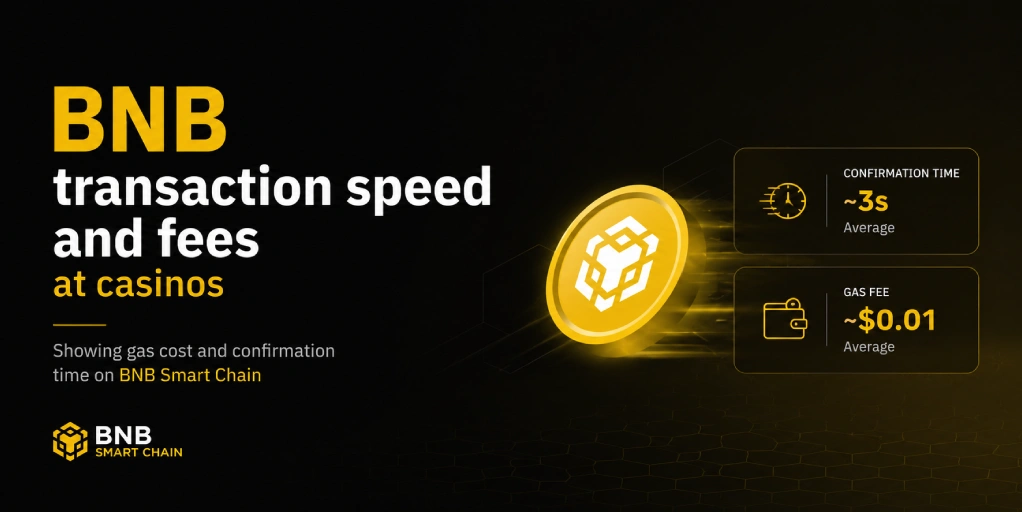
Table of contents
The Two Costs: Network Fees and Casino Fees
When you move BNB to or from a casino, there are potentially two separate costs, and it helps to keep them apart. The first is the network fee — the gas paid to BNB Smart Chain validators to process your transaction. This is unavoidable, paid in BNB, and goes to the network, not the casino. The second is any fee the casino itself charges on deposits or withdrawals, which is set by the platform and varies widely.
Most reputable BNB casinos don’t charge a deposit fee at all, and many don’t charge for withdrawals either — the only cost is the network gas. But some add a withdrawal fee or a processing charge, so it’s worth checking the cashier page before you assume a transaction is free. When players complain that a withdrawal “cost too much,” it’s almost always a casino-side fee, not the network, since BNB Smart Chain gas is measured in cents. Understanding which cost is which tells you whether a fee is something you can avoid by switching platforms or something inherent to using the chain.
How Much a BNB Transaction Actually Costs
A standard BNB transfer uses roughly 0.000105 BNB in gas. At a BNB price around $600, that’s about $0.06 — comfortably under a dime. Sending a BEP-20 token like USDT costs a little more because it involves a smart contract interaction rather than a simple transfer, but it’s still typically under $0.30. Either way, you’re paying cents, and the fee is the same whether you move 0.05 BNB or 50 BNB, because gas is priced by computational work, not by the value being sent.
Two things nudge that number. The first is network congestion: when BSC is busy, gas prices rise modestly, though nothing like the spikes seen on Ethereum. The second is the BNB price itself — because gas is paid in BNB, a higher BNB price means a slightly higher dollar-denominated fee for the same transaction. Both effects are small in practice. The one hard requirement is that you must always hold a little BNB for gas, even when sending other tokens; an empty BNB balance means you can’t transact at all. The fee mechanics tie directly into how the network works, which our guide on how BNB transactions work explains in full.
BNB Fees vs Other Networks
The clearest way to see why BNB suits casino play is to compare it directly with the other networks players commonly use. The table below shows typical figures — fees fluctuate with conditions, so treat these as representative ranges rather than fixed prices:
| Network | Typical Transfer Fee | Block Time | Approx. Casino Credit |
|---|---|---|---|
| BNB Smart Chain | $0.05–0.30 | ~3 sec | ~1 min |
| Ethereum | $5–20+ | ~12 sec | a few min |
| Bitcoin | $1–5+ | ~10 min | 30–60 min |
| Litecoin | $0.01–0.10 | ~2.5 min | ~10–20 min |
The pattern is clear: BNB Smart Chain pairs near-instant block times with fees that stay low even when other networks spike. Litecoin is competitive on cost but slower to confirm; Bitcoin is both pricier and far slower; Ethereum’s fees can exceed the size of a small deposit. For a player making frequent deposits and withdrawals, that difference compounds across every transaction. Our comparisons of BNB vs Ethereum casinos and BNB vs Bitcoin casinos go deeper on how each pairing plays out for gambling specifically.
How Fast Are BNB Casino Transactions?
BNB Smart Chain produces a block every 3 seconds, so your transaction is picked up and recorded almost immediately after you send it. Casinos then wait for a number of confirmations — usually 15 to 20 — before treating a deposit as final and crediting it. At 3 seconds per block, that confirmation window takes roughly 45 to 60 seconds. From hitting send to a credited deposit is typically one to two minutes.
That speed is what makes BNB feel suited to fast, repeated play — the kind of crash, dice, and mines rounds where waiting ten minutes between transactions would kill the experience. It’s also why withdrawals feel responsive: once the casino releases a payout, the network delivers it in about a minute. The 3-second block time is a genuine structural advantage, not a marketing figure, and it’s consistent enough that you can rely on it.
Network Speed vs Casino Processing
Here’s the distinction that explains most “slow transaction” complaints. The network’s job ends when your transaction is confirmed on-chain. Everything after that — detecting the deposit, crediting your account, approving and releasing a withdrawal — is the casino’s software, and that’s where variable delays live. A well-built platform credits within seconds of the final confirmation and processes withdrawals automatically. A poorly built or deliberately cautious one might batch transactions, review them manually, or hold withdrawals for checks.
This is why the same BNB transaction can feel instant at one casino and sluggish at another despite identical network conditions. If a deposit hasn’t credited within a few minutes and the transaction shows as confirmed on a block explorer, the holdup is the casino, not BSC. Withdrawals are where this gap is widest, since that’s where platforms apply review and verification — our guide on why BNB withdrawals get delayed covers the casino-side causes in detail, and how to check BNB transactions shows how to confirm which side a delay is on.
How to Minimise Fees and Delays
A few habits keep both cost and waiting time as low as the network allows. On fees: keep a small BNB reserve so you never get stuck mid-transaction, and remember that because gas is fixed per transaction, consolidating into fewer slightly larger deposits is more efficient than many tiny ones — a point our minimum deposit guide covers through the gas-to-deposit ratio. Choosing a casino that doesn’t add its own withdrawal fee also matters more than any network optimisation, since the platform fee is usually the larger of the two when it exists.
On speed: the biggest lever is platform choice, not anything you do at the network level. A casino with automatic processing and no manual review will always feel faster than one without, regardless of how quick BSC is. Completing any KYC early removes the most common withdrawal holdup before it can occur. And confirming you’re sending on BNB Smart Chain avoids the worst-case delay of all — a wrong-network send that never arrives. The smoothest experiences we’ve measured come down to the platform; our deposits and withdrawals guides cover the process, and platforms like Winz and BC.Game have handled BNB transactions quickly and cleanly in our testing. To compare more options, see the full list of casinos accepting BNB.
Always gamble responsibly. Read our responsible gambling page for practical guidance, and see our advertiser disclosure for affiliate information.
FAQ
- How much does a BNB casino transaction cost?
A standard BNB transfer costs roughly 0.000105 BNB in gas — usually under $0.10. BEP-20 token transfers cost a little more but typically stay under $0.30. The casino may add its own fee on top, but the network cost itself is only cents. - How long does a BNB casino transaction take?
The network confirms in about a minute after the 15 to 20 confirmations most casinos require. Total time depends on the casino’s processing — deposits usually credit within one to two minutes, while withdrawals can take longer if the platform reviews them manually. - Why is BNB cheaper than Ethereum for casino play?
BNB Smart Chain uses a validator design that keeps fees low — typically $0.05 to $0.30 per transfer, versus $5 to $20 or more on Ethereum. For frequent deposits and withdrawals, that difference adds up to real money saved over time. - Does the casino or the network charge the fee?
Both can. The network gas fee is unavoidable and paid in BNB. Some casinos add their own deposit or withdrawal fee on top, though many don’t. If a transaction feels expensive, it’s almost always a casino-side fee, since BSC gas is only cents. - Why is my BNB transaction slow if the network is fast?
Because the delay is usually the casino’s processing, not the network. BSC confirms in about a minute, but the casino’s system handles crediting and withdrawal approval after that. A platform that reviews transactions manually will feel slower regardless of network speed. - Do I pay gas on both deposits and withdrawals?
You pay gas on the deposit you send. On withdrawals, the casino broadcasts the transaction and usually covers or deducts the network fee, though some pass it on or add their own charge. Check the cashier page for the platform’s withdrawal fee policy. - Does sending more BNB cost more in fees?
No. Gas is priced by computational work, not transaction value, so moving 0.05 BNB costs the same network fee as moving 50 BNB. This flat structure is what makes both small test deposits and larger transfers practical on BSC. - How can I make BNB withdrawals faster?
Choose a casino with automatic processing, complete any KYC early, and make sure you’re using BNB Smart Chain. The network part is already fast — the main lever is the platform, since its processing and review steps are where most delay occurs.

BNB Casino is an independent website reviewing crypto casinos that accept BNB. We are not a gambling operator and do not accept bets or process payments. Some links are affiliate links, meaning we may earn a commission at no extra cost to you. 18+ only. Please gamble responsibly.