
How KYC Verification Works at BNB Casinos
Last updated: June 10, 2026
BNB casino KYC is the identity verification process licensed platforms use to confirm who their players are before processing significant transactions. It’s standard practice across regulated online gambling worldwide, and BNB casinos that hold a legitimate license are required to apply it under the same anti-money-laundering frameworks that govern traditional operators. This guide explains what verification involves, when BNB casinos typically require it, what documents are needed, and how to complete it smoothly so it doesn’t hold up a payout.
Table of contents
What KYC Is and Why It Exists
KYC stands for Know Your Customer — a set of identity verification procedures that regulated financial services and gambling operators are legally required to conduct. The requirement comes from international anti-money laundering frameworks that hold licensed businesses accountable for knowing who their customers are and ensuring their platforms aren’t used for financial crime.
In practice, KYC means confirming a player’s identity, age, and in some cases their source of funds before processing withdrawals above a certain threshold. It isn’t unique to crypto gambling — it applies to every licensed casino, sportsbook, and financial service operating under AML regulation. A licensed BNB casino applying KYC is behaving exactly as a responsible, compliant operator should.
Why BNB Casinos Require KYC
A common question from players new to crypto gambling is why a BNB casino — one that accepts pseudonymous blockchain transactions — still requires identity documents. The answer is that the payment method and the regulatory obligation are separate.
A casino’s license is issued by a regulatory authority that imposes KYC requirements on the operator, regardless of how players fund their accounts. BNB transactions are recorded on a public blockchain, but a wallet address doesn’t establish age, identity, or legal eligibility to gamble. The license requires the casino to verify those things directly. A BNB casino that holds a Curaçao, MGA, or other reputable license and skips verification entirely would be in breach of the conditions of that license.
This is also why KYC requirements at BNB casinos mirror those at fiat-accepting platforms. The regulatory framework doesn’t distinguish between payment methods — it applies to the operator’s relationship with the player. Licensing, player protection, and AML compliance work the same way whether a deposit arrives as a bank transfer or a BEP-20 token.
When Verification Is Triggered
The timing of KYC varies between platforms, but there are common patterns across licensed BNB casinos.
Before the first withdrawal. The most common model. Players can deposit and play freely, but identity verification is required before any payout is released. This is where most players first encounter KYC, often unexpectedly, when their first withdrawal request triggers a document check.
At deposit or withdrawal thresholds. Many platforms set specific limits — for example, cumulative deposits or withdrawals above a certain amount trigger a verification request. Below the threshold, the account operates without a check; above it, documents are required before the transaction is processed.
At account registration. Some platforms, particularly those regulated under stricter frameworks, require identity verification before a player can deposit at all. This is less common in the BNB casino space but exists at platforms operating under more demanding licenses.
On specific triggering events. Platforms may request additional documentation when a player’s activity changes significantly — a sudden large deposit, a payout substantially larger than typical session amounts, or a change in account details. These triggered checks are standard AML practice, not arbitrary obstacles.
The most practical takeaway is to verify early, regardless of when the casino technically requires it. Completing verification before you have a payout waiting means it never becomes a delay. Our guide on why BNB withdrawals get delayed covers incomplete verification as the most common cause of a held payout.
What Documents Are Typically Required
The standard documentation set at a licensed BNB casino covers identity, address, and in some cases payment method. The exact requirements vary by platform and jurisdiction, but the following are the most commonly requested.
| Document Type | What Is Accepted | Purpose |
|---|---|---|
| Proof of identity | Passport, national ID card, or driving licence | Confirms name, date of birth, and identity |
| Proof of address | Utility bill, bank statement, or official letter (typically dated within 3 months) | Confirms residential address |
| Selfie or liveness check | Photo holding the ID document, or a short video | Confirms you are the person named on the document |
| Source of funds | Bank statement, payslip, or proof of income | Required for larger accounts or high-volume activity |
Most players complete KYC with a passport or national ID for identity, a recent utility bill or bank statement for address, and a selfie. The source-of-funds check is less common and usually only triggered by accounts with high deposit volumes or unusually large payouts — it’s the casino satisfying its obligation to understand where significant sums originate.
Document quality matters. The most common reason a KYC submission is rejected or delayed is poor image quality — blurry photos, expired documents, or images where edges or key text are cut off. Submitting clear, valid documents the first time avoids a back-and-forth that can add days to the process.
How the KYC Process Works at a BNB Casino
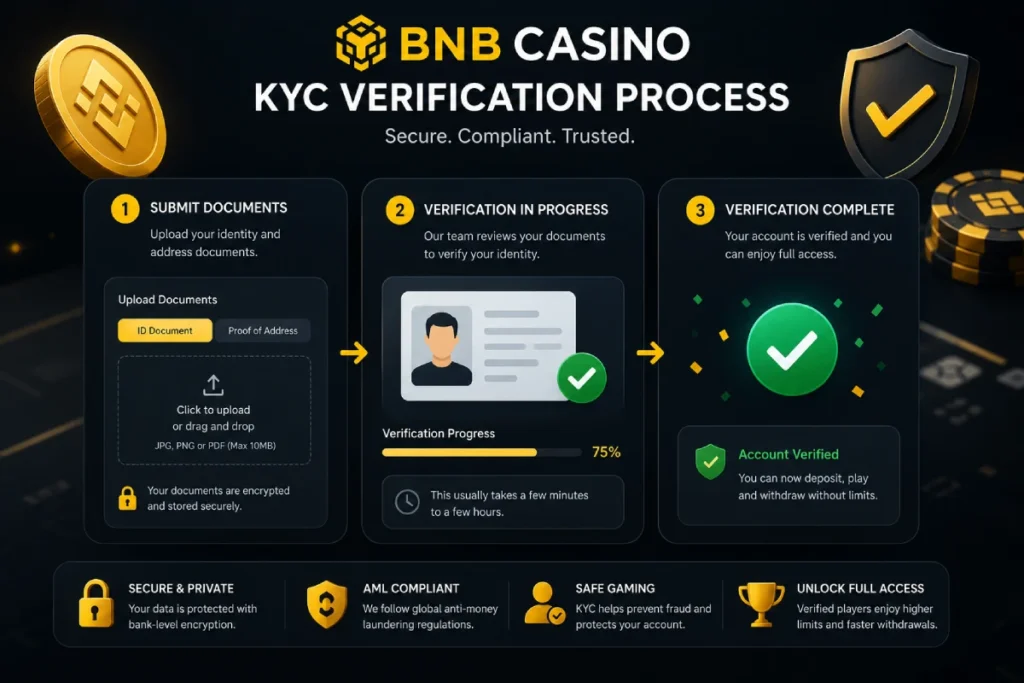
The process is straightforward at any well-built platform. You’ll find a verification section in your account settings or it will be prompted when you make a withdrawal request. From there the steps are consistent across most BNB casinos.
You upload the required documents — identity, address, and any additional items requested — either through the account portal or by responding to an email from the compliance team. The casino’s team reviews the submission, typically within one to three business days though many platforms process it faster. Once approved, your account is verified and the withdrawal limit or restriction is lifted.
Some platforms now use automated verification services that can approve standard submissions in minutes. Others review manually, which takes longer but isn’t unusual. If a submission is rejected, the casino should tell you specifically what was wrong — unclear image, expired document, address doesn’t match — so you can resubmit correctly.
The important thing to remember is that KYC is a one-time process in most cases. Once verified, you don’t redo it for routine deposits and withdrawals at the same casino. You may be asked for updated documents if circumstances change — a new address, account inactivity for a long period — but those are exceptions rather than the rule.
How KYC Protects Players
KYC is usually discussed as something the casino requires, but it also creates protections that benefit the player directly.
A verified account is harder to access fraudulently. If someone attempts to log in and withdraw from your account without your knowledge, the verified identity on file creates a checkpoint — the casino can’t release funds to an address that doesn’t match the account’s history without triggering a review. KYC data also makes it possible for a casino to flag and freeze suspicious activity on your account, which is the same protection that banks apply.
It also confirms the casino takes compliance seriously. A platform that verifies identity is operating under real regulatory obligations, which means it has oversight, accountability, and a framework for handling player complaints. An unverified platform has none of those structures. The KYC requirement is, in this sense, evidence of legitimacy rather than an obstacle to it.
Age verification through KYC is also the mechanism that enforces the minimum gambling age. Licensed casinos are obligated to confirm that players meet the legal age requirement — that obligation exists whether payments are made in fiat or BNB.
How to Complete KYC Without Delays
A few practical steps make the verification process as fast as possible.
Verify before you need to withdraw. The single most effective habit. Starting verification while you’re playing, rather than when you’re trying to cash out, means a review delay doesn’t hold up your payout. Most platforms let you initiate verification from account settings at any time.
Use current, unexpired documents. An expired passport is a common rejection reason. Make sure all documents are valid at the time of submission. For proof of address, check the date requirement — most platforms want documents dated within 90 days.
Photograph documents in good lighting. Every corner should be visible, the text should be legible, and there should be no glare or shadows obscuring key information. A clear, well-lit photo taken against a dark background works well. PDFs directly from a bank or utility provider are even better if accepted.
Ensure your details are consistent. The name, address, and date of birth in your casino account should match your documents exactly. Discrepancies — a nickname instead of a full legal name, an old address — flag for manual review and slow the process down.
Respond promptly to requests. If the casino asks for an additional document or a clearer image, respond quickly. A verification in progress that goes unanswered will stall indefinitely, and in some cases the casino may decline the withdrawal request after a waiting period has passed.
For a broader look at what makes a BNB casino trustworthy beyond verification, our guide on whether BNB casinos are safe covers licensing, game fairness, and other indicators. For choosing a platform with clear, reasonable KYC policies, see our how to choose a BNB casino guide and tested casino reviews — Fairspin and Vavada are among the platforms with transparent verification processes in our testing. To compare options, browse the best BNB casinos.
Always gamble responsibly. Read our responsible gambling page for practical guidance, and see our advertiser disclosure for affiliate information.
FAQ
- What is KYC at a BNB casino?
KYC — Know Your Customer — is the identity verification process licensed BNB casinos use to confirm a player’s identity, age, and address. It’s a standard regulatory requirement under anti-money-laundering frameworks that applies to all licensed gambling operators, regardless of which payment method they accept. - Why do BNB casinos ask for identity documents?
Because their licenses require it. A casino’s regulatory obligations apply to how it manages players, not just how payments are made. BNB’s blockchain records transactions publicly, but a wallet address doesn’t confirm age or identity — the casino must verify those directly to remain compliant. - When does a BNB casino ask for KYC?
Most commonly before the first withdrawal, though some platforms ask at account registration or when transactions exceed a threshold. The trigger varies by platform and its licensing framework. Completing verification early — before a payout is waiting — prevents it from causing a delay. - What documents do I need for BNB casino KYC?
Typically a government-issued photo ID (passport, national ID card, or driving licence), proof of address (utility bill or bank statement, usually dated within 3 months), and sometimes a selfie. Source-of-funds documentation is occasionally requested for higher-volume accounts. - How long does BNB casino KYC take?
Platforms with automated verification can approve a standard submission within minutes. Manual review typically takes one to three business days. Delays usually come from unclear document images, discrepancies in account details, or slow responses to additional requests — all avoidable with good document preparation. - Is KYC required every time I withdraw BNB?
No. Verification is a one-time process at most casinos. Once your account is verified, routine deposits and withdrawals proceed without repeating it. You may be asked to update documents if they expire or if your circumstances change significantly. - My KYC was rejected — what should I do?
Check what the casino specified as the reason. Common rejections are blurry or cropped images, expired documents, or a name that doesn’t match exactly. Correct the issue and resubmit. If the reason isn’t clear, contact support and ask for specifics before resubmitting. - Does KYC mean a BNB casino is legitimate?
KYC is a requirement of licensed, regulated operators — so yes, a casino applying it is operating under real regulatory obligations. It’s a signal that the platform has oversight and accountability. An operator that skips identity verification entirely is likely unlicensed and should be treated with corresponding caution.

BNB Casino is an independent website reviewing crypto casinos that accept BNB. We are not a gambling operator and do not accept bets or process payments. Some links are affiliate links, meaning we may earn a commission at no extra cost to you. 18+ only. Please gamble responsibly.