
Binance Smart Chain (BSC) Made Simple
Last updated: May 9, 2026
BNB Smart Chain costs somewhere between $0.05 and $0.30 per transaction, confirms blocks every 3 seconds, and works with MetaMask and Trust Wallet out of the box. That combination — not any particular technological breakthrough — is why it became the network of choice for a large portion of crypto casino players. If you are using BNB casinos and have not thought much about the network underneath your deposits, this guide is worth reading before your next transfer.
This guide covers what BSC actually is, the numbers that matter for casino use, where it has real weaknesses, and what you need to do the first time you move BNB to a gambling platform.
Table of contents
The Basics: What Exactly Is BNB Smart Chain?
BNB Smart Chain — still widely called BSC — is a blockchain built to run smart contracts. It launched in September 2020 as a companion to the original Binance Chain, which was fast but limited to basic token transfers and trading. BSC added the programmable layer: the ability to run code on-chain, which opened the door to DeFi applications, games, NFTs, and the kind of casino payment flows that require more than a simple send transaction.
The simplest way to think about it: Binance Chain moved assets quickly, and BSC made those assets do things. Both now sit under the broader BNB Chain umbrella, but the smart contract network is still what most wallets, exchanges, and casino platforms mean when they say BSC or BEP-20. The native currency is BNB, which pays gas fees whether you are moving BNB itself or any token built on top of the network. For a full explanation of the token standard, see our guide to what BEP-20 means.
Why BSC Was Created and Why It Matters for Gambling
By mid-2020, Ethereum’s gas fees had become a serious problem for everyday users. During peak network periods, a single transaction could cost $20, $30, or more — pricing out anyone who wasn’t moving large amounts. Binance built BSC to keep everything developers liked about Ethereum (Solidity, EVM compatibility, the existing tooling) while eliminating the fee problem through a different validator design.
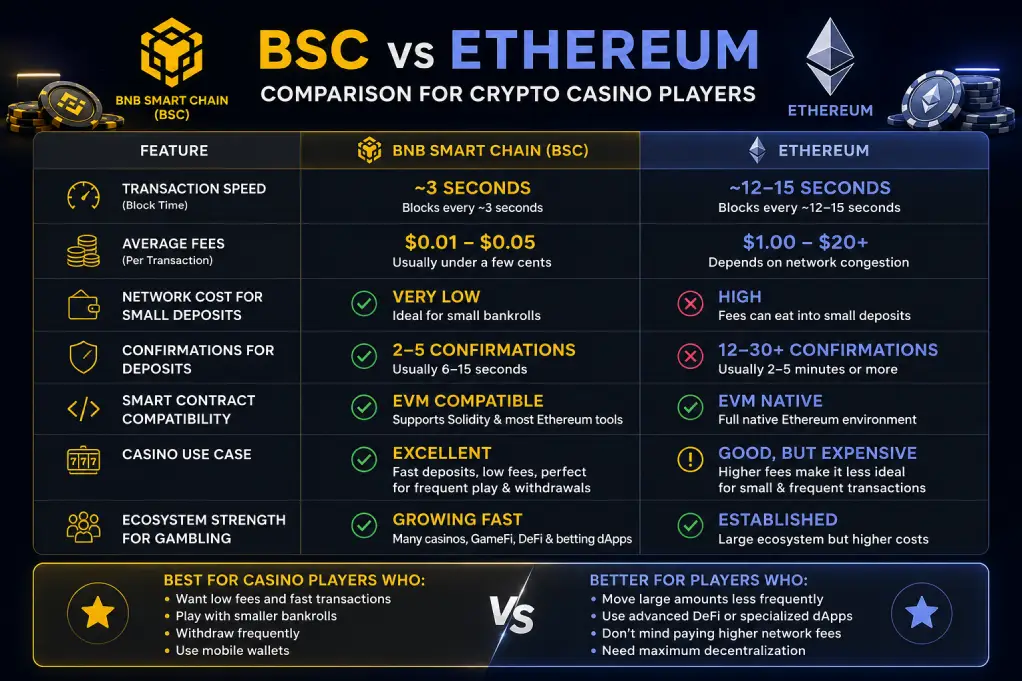
For casino players, that context matters because it explains why the cost difference is so large and why it has stayed that way. BSC fees are not just “lower” — they are consistently low enough that sending 0.05 BNB to test a new casino costs roughly the same network fee as sending 5 BNB. That flat, predictable cost structure is genuinely useful when you are cautious about a new platform and want to test it before committing a real balance. If you are weighing BSC against Ethereum specifically for gambling purposes, our BNB vs Ethereum casinos comparison goes deeper on how the two networks differ in practice. For the broader player-side case for using BNB, see our guide on the benefits of BNB for online gambling.
It also changed how frequently active players behave. When each withdrawal costs $0.10 instead of $15, you stop batching your withdrawals and start moving funds whenever it makes sense. That flexibility — withdraw after a good session, move to a different casino to try a bonus, test a provably fair game with a small stake — is only practical on a low-fee network.
How BSC Works in Simple Terms
BSC uses a consensus mechanism called Proof of Staked Authority (PoSA). There are 21 active validators at any given time, selected based on the amount of BNB they have staked. These validators take turns producing blocks, and one block is produced every 3 seconds. That 3-second block time is what makes deposits feel fast — your transaction gets picked up and confirmed within a few block cycles rather than sitting in a mempool waiting for miner attention.
BSC is also EVM-compatible, meaning it uses the same smart contract language and architecture as Ethereum. Practically, this means any developer who knows Ethereum can deploy on BSC with minor changes, which is why support arrived quickly across wallets, DeFi tools, and casino platforms. It also means MetaMask — which was built for Ethereum — can be configured to work with BSC by adding the network manually, a process that takes about two minutes.
One thing worth understanding: the blockchain confirming your transaction quickly does not mean your funds land in the casino instantly. The network’s job ends when it records the transaction. What happens next — the casino detecting the deposit, crediting your account, making it playable — is entirely up to the platform. Some do this in seconds, others take a few minutes, and a poorly built system can take much longer regardless of how fast BSC is. For a full breakdown of what happens between sending and playing, see our guide to BNB transaction speed and fees at casinos.
BSC for Online Casinos: Real-World Advantages
The fee structure is the clearest advantage. At current network conditions, a standard BNB transfer on BSC costs roughly 0.000105 BNB in gas — at a BNB price of around $600, that works out to under $0.10 per transaction. Compare that to Ethereum, where the same transfer might cost $5 to $20 depending on congestion. For casino players who deposit frequently, test multiple platforms, or want to withdraw smaller amounts without losing a percentage to fees, that difference is real money.
Speed is the second practical advantage. A 3-second block time means your deposit transaction is typically included in the chain within 15 seconds of sending it. Most BSC-compatible casinos credit deposits after 15 to 20 block confirmations, which takes roughly one minute from when you hit send. That is fast enough to feel seamless during normal play. Our BNB casino deposit guide walks through what to expect step by step.
BSC also suits the game types crypto players tend to prefer. Crash, dice, mines, and plinko require fast, low-friction transactions — games where you might be making multiple rounds per minute. A network with high fees or slow confirmations would make those game types impractical for small-stakes play. Our BNB Crash page covers one of the most popular examples in the category.
Finally, wallet support is seamless. MetaMask requires adding BSC as a custom network (RPC URL: https://bsc-dataseed.binance.org/, Chain ID: 56), which takes two minutes and works across desktop and mobile. Trust Wallet supports BSC natively with no configuration needed. For players who prefer mobile-first gambling, that matters. Both wallet setup processes are covered in our guides on using MetaMask for BNB and using Trust Wallet for BNB.
Potential Drawbacks of Using BSC
The 21-validator design that makes BSC fast is also its most significant trade-off. Ethereum has tens of thousands of validators spread across independent operators worldwide. BSC’s 21 active validators are fewer, and many are associated with Binance-connected entities, which creates a more centralized trust model. For most casino use — deposits, withdrawals, balance management — this does not affect your experience day to day. But it is worth knowing that BSC’s security assumptions are different from Ethereum’s, not just its speed.
BSC has also had its share of smart contract exploits over the years, most of them targeting DeFi protocols rather than casino platforms directly. The network itself has not been compromised, but the ecosystem’s openness — anyone can deploy anything — means risky projects exist alongside reputable ones. For players, the implication is simple: the network being reputable does not mean every casino running on it is. Platform selection still matters. Our BNB casino safety guide explains what to check before depositing anywhere.
BNB’s price volatility is a factor that many players underestimate when they first switch to crypto gambling. If you deposit 1 BNB at $600 and the price drops to $500 before you withdraw, your casino balance has lost $100 in purchasing power without you losing a single game. The opposite is also true. Keeping a large balance on a casino platform amplifies this risk — casino accounts are not wallets, and they carry platform risk on top of market risk. Move funds out when you are done playing.
How to Get Started with BSC for Casino Play
The steps are straightforward, but the one detail that causes most problems is network selection. When you withdraw BNB from an exchange like Binance or Coinbase, you will be asked which network to use. Select BNB Smart Chain or BEP-20 — not the BNB Beacon Chain (BEP-2), not Ethereum. Sending BNB on the wrong network means the funds arrive at an address on a different chain. Recovery is sometimes possible through the receiving wallet or exchange, but it is not guaranteed and often involves support tickets and waiting.
Before making any significant transfer, send a small test amount first — 0.01 BNB is enough to confirm the address and network are correct without risking your whole balance. This habit costs almost nothing on BSC and has saved many players from expensive mistakes. Once the test arrives, proceed with your full deposit. The complete process is covered step by step in our guide on depositing BNB at a casino.
On the casino side, always verify the deposit page specifies BNB Smart Chain, BSC, or BEP-20 clearly. If the page just says “BNB” without a network label, ask support before sending. Reputable platforms make this explicit. A casino that is vague about network details is telling you something about how carefully they handle technical specifics.
Final Thoughts: Is BSC Right for You?
For most crypto casino players, yes. The fee structure alone makes it worth using over Ethereum for gambling purposes — paying $0.10 instead of $15 per transaction is a real, repeating benefit that compounds across every deposit and withdrawal you make. The 3-second block time makes the deposit experience feel fast and modern. And the wallet compatibility means you are not locked into proprietary apps or complex setups.
The centralization trade-off is real but not a dealbreaker for the use case. You are not storing your life savings on BSC — you are moving gambling funds in and out of specific platforms. The relevant risks are casino platform risk and your own wallet security, both of which you control. BSC itself has proven reliable for this purpose across hundreds of millions of transactions.
Start with our best BNB casinos list to compare platforms, then use how to choose a BNB casino and our casino reviews section to go deeper on any platform that interests you.
Always gamble responsibly. Read our responsible gambling page for practical guidance, and see our advertiser disclosure for affiliate information. For more about the people behind the site, visit About or Contact.
FAQ
- Is Binance Smart Chain the same as BNB Smart Chain?
Yes. Binance rebranded the ecosystem to BNB Chain in early 2022, but the underlying smart contract network is the same. Wallets, exchanges, and casino platforms use BSC and BNB Smart Chain interchangeably, and the network ID (Chain ID 56) has not changed. - Why do crypto casinos use BNB Smart Chain?
Primarily because of fees and speed. A BSC transaction costs under $0.30 in most conditions and confirms in roughly one minute including casino processing time. That makes frequent deposits and smaller withdrawals practical in a way that Ethereum does not. - Is BSC cheaper than Ethereum for casino deposits?
Significantly cheaper in most cases. BSC gas fees typically run between $0.05 and $0.30 per transaction. Ethereum fees during normal usage range from $5 to $20, and can exceed $50 during high-congestion periods. For a player making 20 deposits per month, that difference is $100 to $400 in fees alone. - Can I use MetaMask with BNB Smart Chain?
Yes, but you need to add BSC as a custom network. Use RPC URL https://bsc-dataseed.binance.org/ and Chain ID 56. The process takes about two minutes and is a one-time setup. After that, MetaMask switches between Ethereum and BSC the same way it switches between any two networks. - What happens if I send BNB on the wrong network?
Your funds land at the correct address but on the wrong chain, where the receiving wallet or casino may not see them. Recovery depends entirely on whether the receiving platform supports the chain you accidentally used. Some exchanges can recover it through support. Some cannot. Send a small test first every time you use a new address. - Is BNB Smart Chain safe for gambling?
BSC the network is well-established and has not been compromised. The safety question for casino players is really about the platform, not the network. Use casinos with clear licensing, visible withdrawal policies, and a track record of paying out. Our safety guide covers what to check. - Does BSC make casino withdrawals instant?
The network confirms transactions in roughly 15 to 60 seconds depending on block timing. Whether that translates to instant withdrawals depends entirely on the casino. Platforms that process withdrawals manually or batch them on a schedule will be slow regardless of how fast BSC is. The casino’s processing time is almost always the longer variable. - Do I need BNB for gas fees?
Yes, always. BNB pays gas fees on BNB Smart Chain for every transaction — including transfers of USDT, BUSD, or any other BEP-20 token. If your wallet runs out of BNB, you cannot send anything until you add more, even if you have other tokens available.

BNB Casino is an independent website reviewing crypto casinos that accept BNB. We are not a gambling operator and do not accept bets or process payments. Some links are affiliate links, meaning we may earn a commission at no extra cost to you. 18+ only. Please gamble responsibly.