
BEP-20 Tokens Explained in Plain English
Last updated: June 1, 2026
Every time you deposit BNB or a BNB-based token at a crypto casino accepting BNB, that transaction follows a set of rules called BEP-20. You won’t see the standard named anywhere on the deposit page — it runs in the background. But knowing what BEP-20 is explains a few things that trip people up: why you need BNB for gas even when sending USDT, why the wrong network makes funds vanish, and why certain tokens don’t show in your wallet until you add them manually.
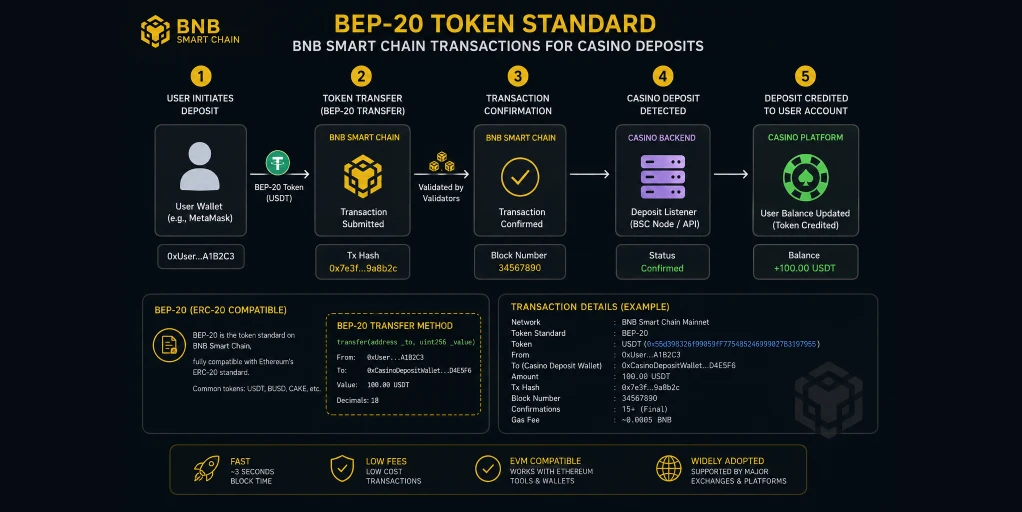
Table of contents
What BEP-20 Actually Is
BEP-20 is a token standard — a technical specification that defines how tokens behave on BNB Smart Chain. Every compliant token has a name, a symbol, a set number of decimal places, a total supply, and the ability to move between addresses. Because they all follow the same rules, wallets, exchanges, and casino platforms don’t need to build separate handling for each one. Support one BEP-20 token, and you essentially support all of them.
BEP-20 was modelled on Ethereum’s ERC-20 standard. BSC was built to be EVM-compatible — it runs the same smart contract language as Ethereum — so adapting ERC-20 into BEP-20 was mostly a matter of swapping the underlying network. That compatibility is why MetaMask works on BSC without any real changes, and why developers who already knew Ethereum could ship tokens on BSC from day one. For more on the network BEP-20 runs on, see our guide to what BNB Smart Chain is.
BEP-20 vs ERC-20: The Difference That Matters
At the code level, BEP-20 and ERC-20 are nearly identical. Same functions, same structure, both work in MetaMask. The gap that matters for casino players is not in the code — it’s in the fees.
Sending ERC-20 USDT on Ethereum costs between $5 and $20 in gas during normal conditions, sometimes more during busy periods. The same transfer on BSC as BEP-20 costs under $0.10. The tokens are worth the same. The networks are not. If you’re depositing regularly, testing new platforms, or moving smaller amounts between wallets, that cost difference adds up fast. Our guide to how BNB transactions work explains why fees and confirmation times differ so much between networks.
Speed is also different. BSC produces a block every 3 seconds. Most BNB casinos credit deposits after 15 to 20 confirmations, which takes roughly a minute from the moment you send. Ethereum takes longer by design. For casino use, the BSC timing feels seamless — you send, and by the time you’ve navigated to the game lobby, the balance is usually there.
Which Tokens Use BEP-20?
BNB is the native currency of BNB Smart Chain, so it works slightly differently from issued tokens — but for casino deposits and withdrawals, it behaves the same as any BEP-20 asset. When you send BNB to a BSC deposit address, it lands the same way USDT or USDC would.
The BEP-20 tokens you’ll run into most at crypto gambling platforms are USDT, USDC, and BUSD (mostly phased out now but still circulating on some platforms). Some casinos also issue their own BEP-20 tokens for loyalty points or platform rewards. If the deposit page shows BSC, BNB Smart Chain, or BEP-20 next to a token name, that token is on this standard.
One thing that confuses people: USDT exists on multiple chains at once. There’s ERC-20 USDT on Ethereum, BEP-20 USDT on BSC, TRC-20 USDT on Tron, and others. Same dollar value, different networks — and they’re not interchangeable. Sending Tron USDT to a casino that only watches for BSC transactions is one of the more common ways players lose funds temporarily. The casino’s deposit address is chain-specific, even if it looks identical to an address on another network.
Why You Always Need BNB for Gas
Gas fees on BNB Smart Chain are paid in BNB — always, regardless of which token you’re moving. Want to send BEP-20 USDT to a casino? You still need BNB in that wallet to cover the fee. Zero BNB means the transaction won’t go through, even if you’re sitting on a full USDT balance.
The fees themselves are tiny — typically 0.0001 to 0.0005 BNB, which is a few cents at most. The problem is when you drain your BNB completely in one transfer and then can’t send anything else. You can’t pay gas with USDT. You can’t convert within the wallet. You have to go back to an exchange, buy a small amount of BNB, and send it to the wallet first. Just keeping 0.01 BNB parked in your wallet permanently avoids this entirely. Our BNB wallets guide covers which options handle the gas reserve situation most cleanly.
BEP-20 and Casino Deposits: What to Watch
A well-built casino deposit page will clearly show which network it expects: BSC, BNB Smart Chain, or BEP-20. Those all mean the same thing. If the page just says “BNB” with no network label, ask support before you send anything. It’s not an overreaction — a vague deposit page is often a sign that the platform hasn’t thought carefully about the technical side, which tends to matter more when something goes wrong.
Most platforms that properly support BNB will credit deposits within one to two minutes of on-chain confirmation. If five minutes pass and the balance hasn’t moved, check a block explorer to confirm the transaction went through. If it did, the hold-up is the casino’s internal processing, not the network. Our BNB deposit guide walks through the full flow step by step. For when things go sideways, the stuck transaction guide covers the most common causes and fixes.
Also worth checking before your first deposit: the minimum. Some platforms set surprisingly high minimums given how cheap BSC transactions actually are. The minimum deposit guide has current numbers for the main platforms. If you want somewhere to start, BC.Game, Stake, and BetFury all handle BEP-20 correctly — clearly labeled, fast to credit, no surprises on the deposit page.
The Wrong Network Problem
The most common BEP-20 mistake: sending on the wrong network. It usually happens at the withdrawal stage on an exchange. You select BNB, the exchange asks which network, and you pick Ethereum instead of BNB Smart Chain — either out of habit or because the dropdown isn’t obvious.
What happens is your funds arrive at the right address on the wrong chain. The casino’s system watches for deposits on BSC. It’s not watching Ethereum. The money isn’t gone — it exists at that address on Ethereum — but getting it back depends on whether the casino controls the private key for that address on Ethereum, which many don’t expose easily. Some will recover it through a support ticket. Others can’t. The fix is simple: send a small test — 0.01 BNB — every time you use a new deposit address. It costs almost nothing on BSC and confirms the network is correct before you move a real amount.
For a broader look at what tends to go wrong with BNB gambling transactions, our common BNB gambling mistakes guide is worth reading before your first deposit. When you’re ready to send, our guide on how to deposit BNB at a casino covers the full process. And if you’re still picking a platform, the list of BNB casinos is the best place to start.
Always gamble responsibly. Read our responsible gambling page for practical guidance, and see our advertiser disclosure for affiliate information.
FAQ
- What does BEP-20 mean?
BEP-20 is the token standard used on BNB Smart Chain. It defines how tokens are created, transferred, and managed on the network. Any token running on BSC — including USDT, USDC, and custom casino tokens — follows this specification. - Is BEP-20 the same as BNB?
Not exactly. BNB is the native currency of BNB Smart Chain, while BEP-20 is the standard that other tokens on the chain follow. BNB isn’t technically issued as a BEP-20 token, but for deposits and withdrawals at a casino it behaves the same way. - What is the difference between BEP-20 and ERC-20?
The code is nearly identical — both define fungible tokens on EVM-compatible blockchains. The difference is the network. ERC-20 is on Ethereum, where gas typically costs $5–$20 per transaction. BEP-20 is on BSC, where the same transfer costs under $0.10. - Do I need BNB to send BEP-20 tokens?
Yes, always. Gas on BNB Smart Chain is paid in BNB regardless of what you’re sending. Transferring USDT still requires BNB in the wallet for the fee. Keep at least 0.01 BNB in your wallet and you won’t run into this problem. - How do I know if a casino supports BEP-20?
The deposit page should clearly say BSC, BNB Smart Chain, or BEP-20 next to the token. If it just says “BNB” with no network label, ask support before sending. Any reputable platform makes the network explicit. - What happens if I send BEP-20 tokens to the wrong network?
Your funds arrive at the correct address but on the wrong blockchain. The casino isn’t monitoring that chain, so the deposit won’t register. Recovery depends on whether the platform can access the private key for that address on the other network — some can, many can’t. Always send a small test first. - Can USDT be both BEP-20 and ERC-20?
Yes. Tether issues USDT on multiple chains simultaneously. BEP-20 USDT and ERC-20 USDT have the same dollar value but live on separate networks and can’t be sent interchangeably. Check which version the casino expects before you send. - Is BEP-20 safe to use for gambling?
BSC has been running without a network-level compromise since 2020. The safety question for players is really about which casino you’re using, not the token standard itself. Our guide on BNB casino safety covers what to check before depositing anywhere.

BNB Casino is an independent website reviewing crypto casinos that accept BNB. We are not a gambling operator and do not accept bets or process payments. Some links are affiliate links, meaning we may earn a commission at no extra cost to you. 18+ only. Please gamble responsibly.